The Best Mobile Games Aren't Just Built. They're Operated.


In-game content is still king. But the crown goes to whoever can deliver new content, shaped for each player, at exactly the right moment.
The era of buying growth in mobile gaming is over. Acquisition costs have made it uneconomical for most studios. Sensor Tower found that 78% of the top 1,000 mobile games by revenue declined in the first half of 2025. The only path to sustainable revenue runs through the players you already have.
Easier said than done.
Keeping those players engaged takes more than a great core loop. What keeps them spending, returning, and coming back is everything built around it: the missions that give each session a purpose, the milestones that reward progress over time, the limited-time events that create urgency, the seasonal events, the personal offers. That meta-game layer is where retention and revenue are won or lost. And it only works when it stays fresh. Players go blind to features they've seen a hundred times - novelty is what makes them look again.
Which sounds exhausting… Until you build for it.
Create it once. Use it a thousand times.
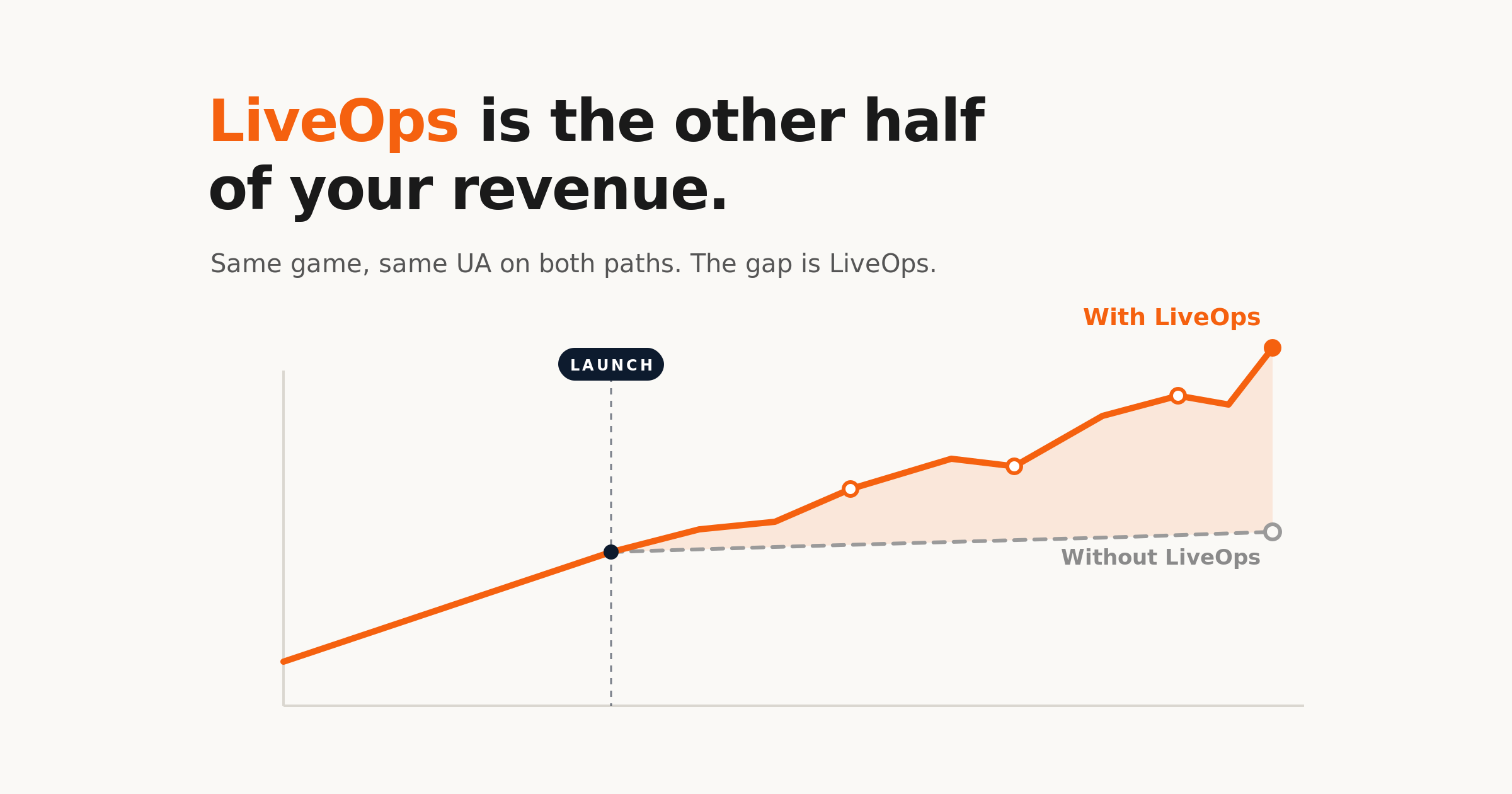
Dynamic content starts with a simple idea: a developer shouldn't have to touch code every time a new campaign or in-app experience goes live. When your content system is built on reusable templates, your creative output grows even when your team doesn't. You build the foundation once and your operators run with it. A new offer, a new message, a new mission, a new in-app experience, can be decided in the morning and live by the afternoon. The infrastructure you invest in today pays out on every campaign that follows.
Erez, who runs LiveOps for Tetris Block Party at PlayStudios, a Kinoa customer, put this into practice when the team wanted to run a coupon promotion. Instead of building a coupon system from scratch, they reused an existing prize wheel and swapped the prizes for coupons. There's no “coupon” feature in the code - the coupons are just images, controlled remotely through Kinoa. Spin the wheel, win a coupon, and the discount shows up in your store- instantly, and only for you. No new development. On a single day, it drove close to a 50% revenue lift. The reason it worked? Players felt they won the coupon rather than just seeing a sale. Same infrastructure, different content, completely different psychology.
React to what's happening, not what you predicted.
Players don't behave the way your Q3 planning doc predicted. Dynamic content gives you the ability to respond to what's real. Your payers are churning? You can act today. A segment of high-value users who haven't made a second purchase? Reach them with something specific. The product stops being a snapshot of what you planned and starts being a reflection of what's working right now.
The right experience, for the right player, changes everything.
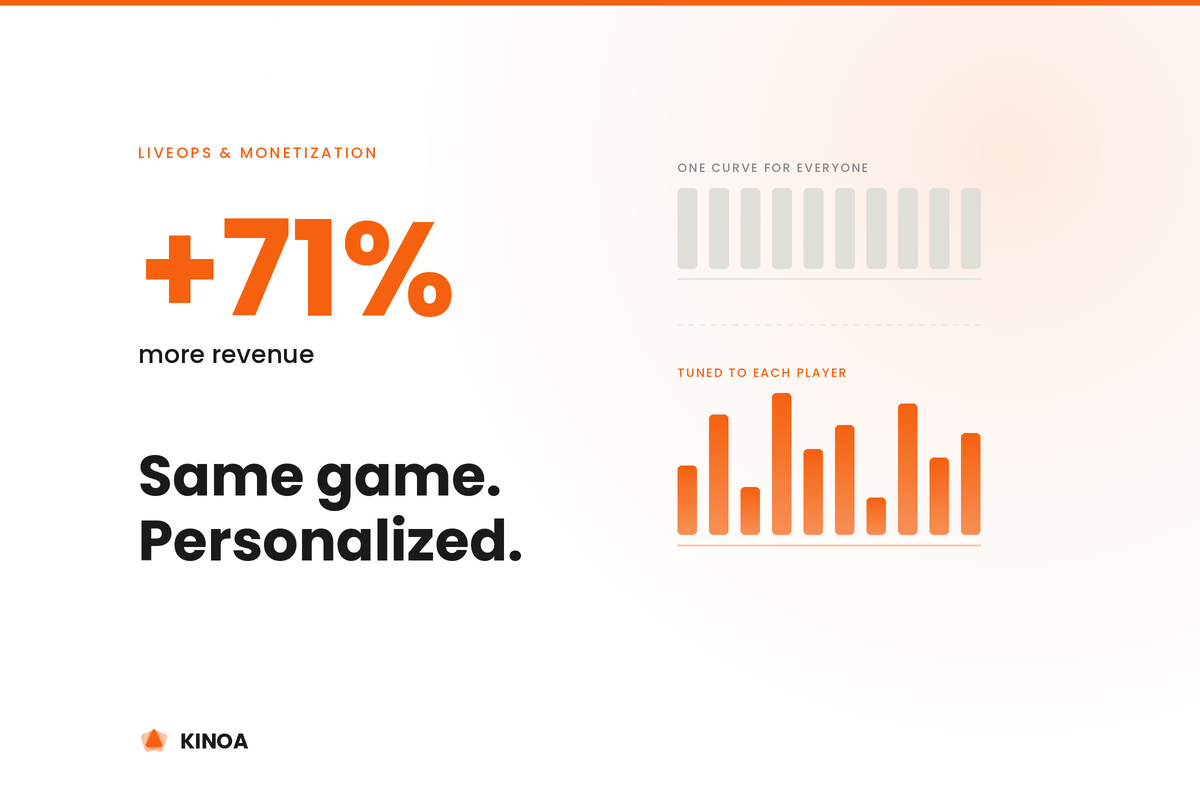
Players feel the difference between a generic push notification and an offer that lands at exactly the right moment. Dynamic content is what makes that possible at scale. Instead of planning one experience for all players, you build content that responds to where each player actually is. Real-time segmentation groups players by what they're doing right now, not who they were last week. Personalized user flows then guide each player through a journey tailored to their behavior. The experience starts responding to the player instead of running on a schedule someone set months ago.
Don't argue about it. Test it.
The teams that dominate revenue aren't the ones with the best ideas. They're the ones who test the most. You'd be surprised how often the "obvious" hypothesis turns out exactly backwards. The offer everyone agreed would work, doesn't - the one nobody believed in wins the test. Run variants, let the data pick the winner, and move on. Studios that do this continuously don't just find what works. They build a compounding knowledge base their competitors don't have.
Operate at the speed of your imagination.
When shipping takes weeks, you only greenlight the safe bets. The strange ideas, the hunches, the "what if we just-" experiments never make it out of the meeting. When shipping takes hours, there's no reason to kill them. You run them. And some of your weirdest hunches turn out to be your biggest wins.
AI doesn't replace operators. It amplifies them.
The challenge with everything described above is capacity. Real-time segmentation, personalized flows, dynamic content, continuous A/B testing. Done well, this is a full-time operation. AI changes that equation. A liveops manager describes a campaign or in-app experience in plain language, and the system builds it, targets it, runs the test, and surfaces what worked. The bottleneck shifts from execution to imagination.
The vision isn't just faster operations. It's one operator doing the work of ten, not by cutting corners, but by removing the execution layer entirely. The human focuses on strategy, creativity, and judgment. The machine handles the rest.
This is where LiveOps is heading. And it's where Kinoa is going.
The studios building these habits now are the ones who will win in the near future.
In today's market, shipping a great game gets you in the door. Operating it is how you stay on top.
If you're building toward this kind of operation, we'd love to show you how Kinoa makes it possible. Schedule a demo here