The Operations Gap: why live ops now decides who wins in mobile

I spent fifteen years helping hundreds of studios acquire users. Then the model that defined my career broke, and what replaced it changed how I think about mobile revenue.
For fifteen years, my job was to help mobile game and app companies acquire users. I co-founded two ad-tech companies and sold them, Adotomi to Matomy Media Group and Adquant to Skai, formerly Kenshoo. Across that time I had a hand in bllions of dollars of acquisition spend. If there was a way to buy a mobile user, I had tried it. For most of those years, the model just worked. Buy installs, earn it back through monetization, repeat. Acquisition answered almost every question a studio could ask. Then it stopped.
Acquistion stopped being the edge
The shift did not arrive all at once. Install costs climbed more than 40%. And targeting grew less effective, as Apple's App Tracking Transparency and the loss of the IDFA cut off the signals that made it precise in the first place. The obvious conclusion was that acquisition had simply become more expensive, and for a while that is how most of us read it. But the harder truth was that it had also become less effective: paying more to reach the right users, and reaching fewer of them. Studios were already adjusting. Last year, remarketing spend on existing users reached $31.3 billion, up 37% year over year and growing far faster than user acquisition. Reengagement now takes 29% of app marketing budgets, up from 25% a year earlier. The market was quietly moving toward the users it already had.
But when I looked closely at who was actually pulling ahead, expense was not the story.
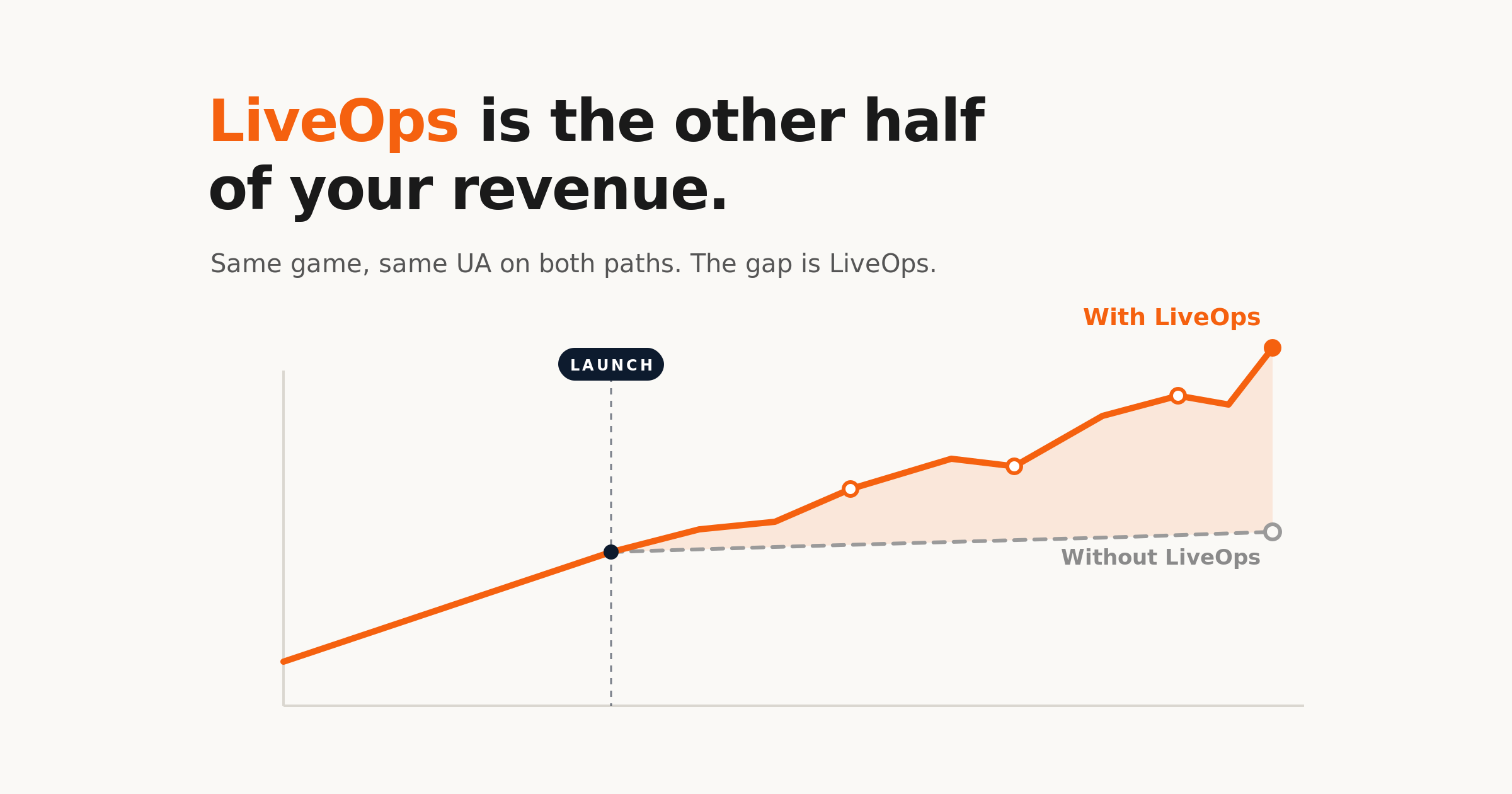
The studios winning were not acquiring more. They were operating better. Whiteout Survival ran 50 monetization events in a single month. Gossip Harbor shipped 39 new events across a year and climbed to the top of casual puzzle. Meanwhile, 78% of the top 1,000 mobile games saw revenue decline year over year. Same market, opposite outcomes.
Live ops became the difference between pulling ahead and quietly declining
Live ops had become the dividing line. Not whether a team ran it, but how well: the precision, variety, sophistication, and cadence of how they operated every single day. The leaders treated live ops as the core of the business, tuned continuously across a live user base at real scale.
Operating at that level is enormously hard. The studios doing it had built the machine in-house, over years, at significant cost. Everyone else was locked out.
Not for lack of ambition, but for lack of infrastructure. To run live ops the way the leaders do, you need real-time data, real-time execution, and the ability to change anything without waiting on a release. Most teams could not assemble that, so they ran a fraction of what was possible and watched revenue they had already earned slip away.
Putting that machine in everyone's hands
That is the reason I built Kinoa. Most teams sit on far more user data than they can act on. Kinoa turns that data into real-time decisions and execution, so teams earn more revenue from the users they already have.
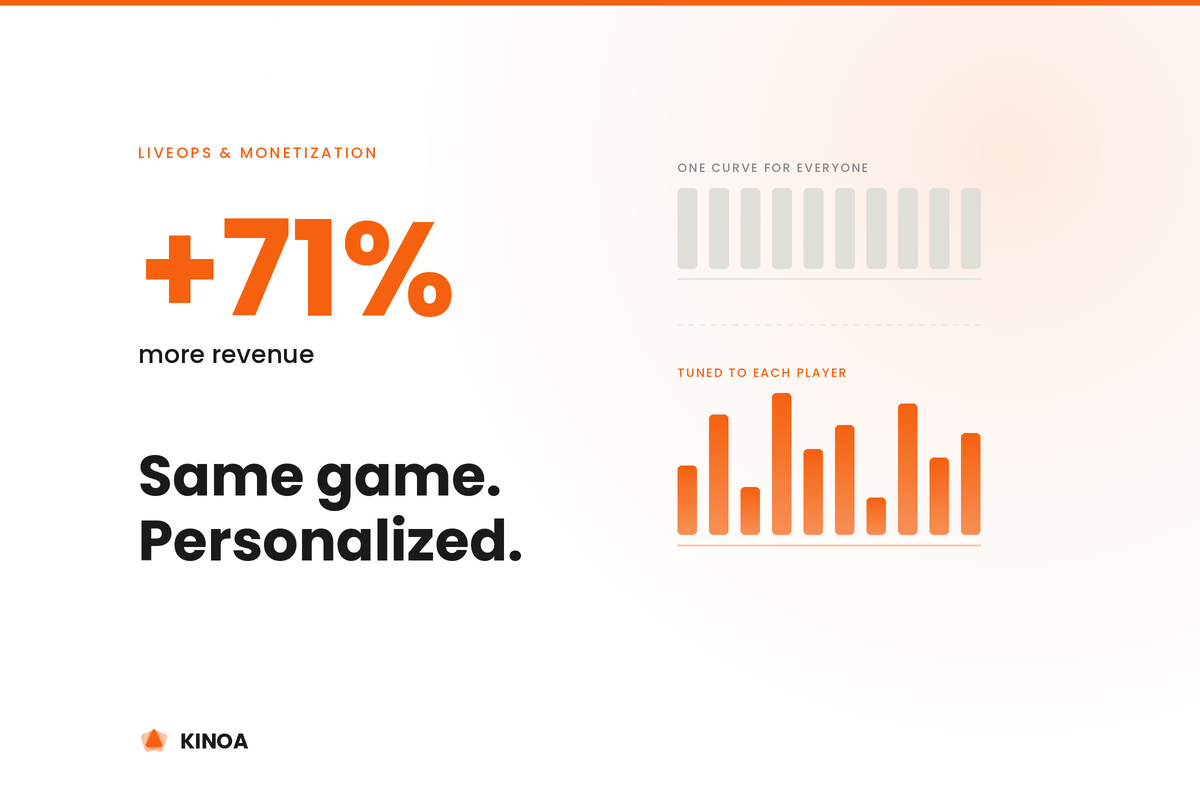
Operators run it themselves, with no code release and no dev ticket. They personalize every user's experience in real time, build complete in-app experiences with Flows, add content that keeps users engaged, run Live Segments that update the instant behavior changes, adjust Feature Settings without a release, and prove what works with A/B Testing. The result is movement on the metrics that decide the business: retention, conversion, and ARPDAU.
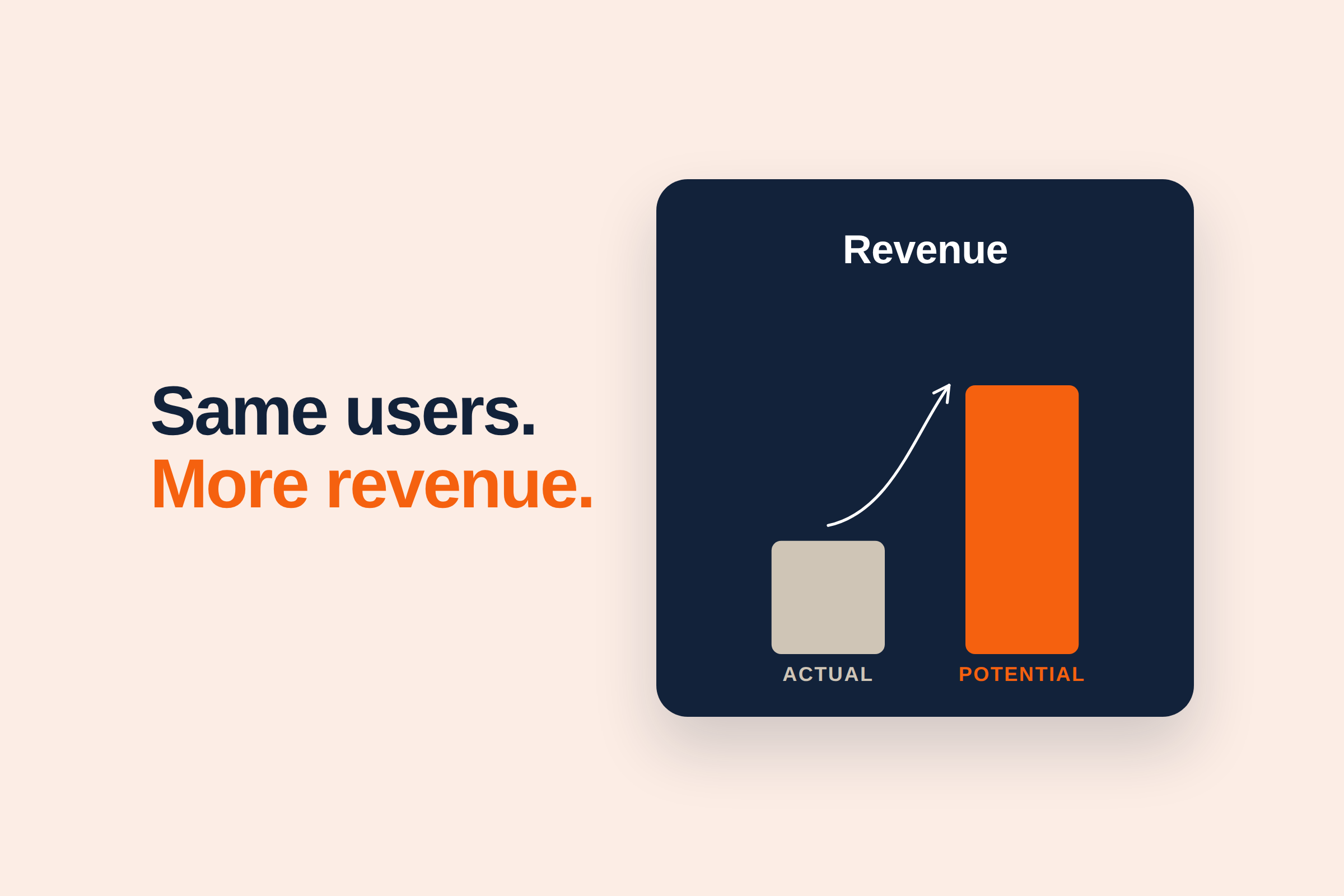
The impact shows up where it counts. Across our customer base, Kinoa consistently unlocks more than 25% revenue lift, with some teams seeing triple-digit improvements.
From Execution to Intelligence
Everything I have described is the execution layer, and it is live today. The next chapter is the intelligence layer.
On top of execution, we are building predictive models with AI that will anticipate who is about to churn, who is ready to pay, and which offer will land for each user before the signals surface. The two layers are designed to work as one loop: prediction drives execution, execution sharpens the next prediction, and AI agents act in the moment while operators supervise outcomes instead of routing every task by hand. Every action makes the next prediction sharper.
The Vision: One operator with the firepower of a team of ten
Here is the future we are building toward. One person running live ops with the precision, speed, and revenue impact of a ten-person team at a large gaming company. The operator sets the strategy. The system runs the machine. That kind of leverage used to belong only to the few studios that could build it in-house. We intend to make it available to everyone.
We just closed our seed round to build exactly that. You can read the full story here.
The mobile market has changed for good. The next decade will not be won at the install. It will be won in live ops, by smaller teams operating with the firepower of much larger ones.