
Personalizing difficulty per player raised revenue 71%

Most studios still can't truly personalize player experience. After years of running LiveOps myself and working with dozens of teams doing the same, I can tell you why, and it is not a data problem.
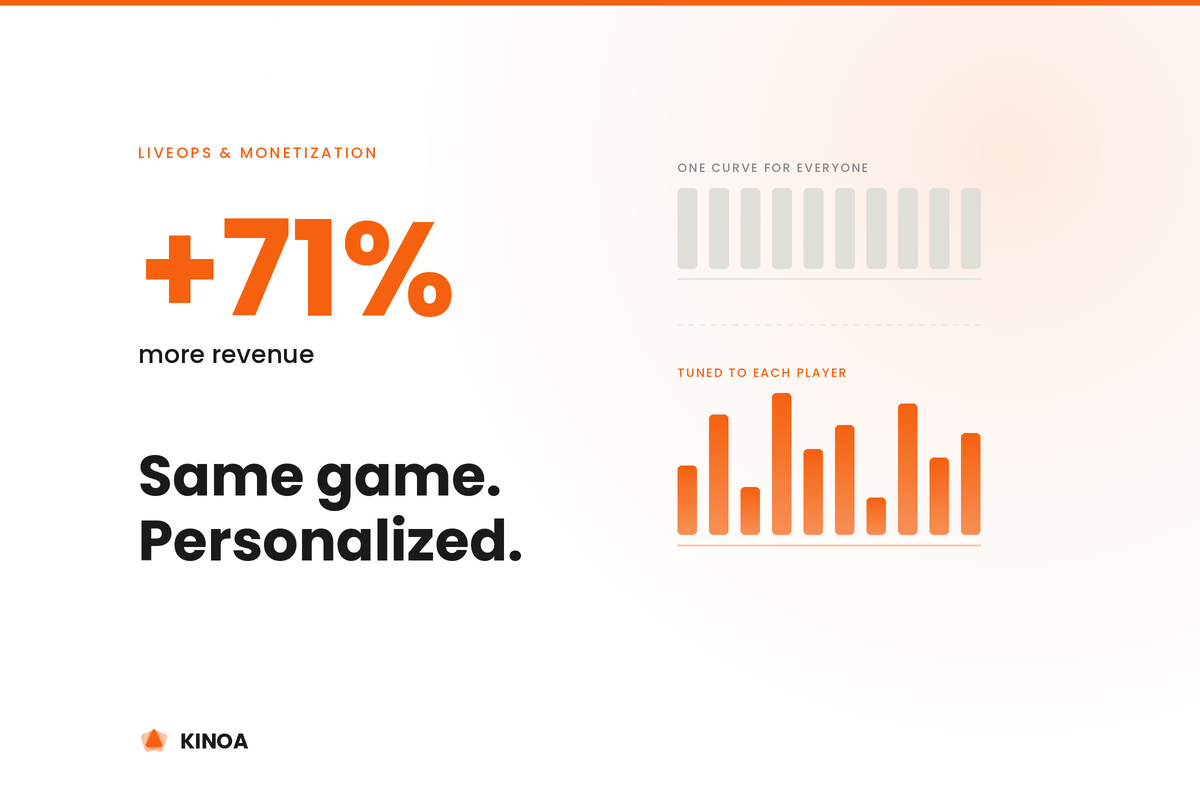
A team of economists took player-level data from a live mobile puzzle game and asked a simple question: what happens to revenue if you tune difficulty to each individual player instead of setting one curve for everyone? Their answer, published in the International Journal of Industrial Organization, was a 71% increase in revenue. The developer had already tuned average difficulty to maximize revenue. Personalization on top of that added most of the value again. The effect held for small spenders and the largest ones alike.
I have spent years in LiveOps, first inside studios running live and new titles, then alongside dozens of teams doing the same work. When I read that number, my reaction was not surprise. It was recognition. That result matches what I saw every time a team started reacting to individual behavior instead of group averages. What surprises me is how few studios are set up to do it.
Why most teams are stuck, and it is not the data
Ask a studio if they personalize and they say yes, then they walk you through their segments. Whales here, mid-spenders there, a lapsing cohort off to the side. That work is real and it matters. It is also not personalization, and this is where almost everyone stops.
A segment says two players belong together because they look alike on paper. Same country, same spend tier, same install week. But sameness is the least useful thing you know about a player. Two people can both be from the same country, the same city and even the same house and be completely different people, with different habits, different motivations, and completely different reasons to open the game tonight.
Segmentation beats sending everyone the same thing. But it stops at the group, and what actually moves the numbers is the difference inside the group. The studios I worked with were not short on data. They had every event they needed. What they lacked was a way to act on it per player, in the moment, without opening a ticket and waiting on a release. That is a tooling problem, not a data problem, and it is the real reason a result like the puzzle game's 71% stays in a journal instead of showing up in live titles.
What matters is not what players have in common. It is what makes each one different, and whether your economy can respond to it in real time.
Personalize the economy, not just the message
The version of this that pays off most is a personalized economy: one that changes shape based on the choices a player makes. Difficulty is the clearest example, and it is exactly what the study measured. Serve an event as easy, medium, or difficult depending on how that specific player behaves- or give him the choice, in real time. Create a purchase offer to fit their exact need in a certain moment of time. Two players open the same game and get two genuinely different games, each one tuned to the specific actions they are taking.
Mechanically this is closer than most teams assume. Difficulty, drop rates, and pricing usually already live in remote values. Point those values at real-time player state instead of one global default and the same event becomes three different events for three different players. No release, no code change, no new build.
One real example: fixing the Day 4 drop
One team I worked with built a flow around a single behavioral signal: time in the app. They noticed that players who only purchased on Day 4 were roughly half as likely to continue to purchase as players who already purchased on Days 1, 2, and 3. You do not see that at the segment level. You only see it when you look at how behavior changes over time.
So they responded to it. They placed a supersized package at that Day 4, at the moment of the first purchase, built to pull hesitant players over the line and keep them playing and paying. The point was never the single sale. It was to create a habit. A player who makes a second purchase is far more likely to become a regular payer. A third makes it likelier still. Catch the drop, build the habit, and payer revenue climbs by tens of percent.
Real-time behavior shaping is the operator's edge
This is the real line between personalization and regular segmentation. Segmentation sends the same thing to everyone in a group, usually on a schedule. Personalization gives the operator control to shape behavior as it happens: if something should have happened and did not, you can step in and prompt that player to act, in the moment, without waiting on a release. In my experience this is not a single-digit optimization. Done well, revenue lift can be tens of percents to even hundreds of percents.
The wider research points the same direction. Mistplay, in its mobile gaming spend research, found that 40% of spenders would spend more if they were given personalized offers. Outside gaming, McKinsey's Next in Personalization study found that faster-growing companies drive 40% more of their revenue from personalization than their slower-growing peers. Different industries, same conclusion.
The 71% revenue lift from tuning difficulty per player was measured on a real game with real players, not modeled in a vacuum. The reason a number like that is not already showing up in your own revenue is almost never the data. It is that acting on a single player, at a single moment, has historically meant a ticket, a sprint, and a release. Segmentation was the sensible workaround. That constraint is gone.
If you have the users, you already have the raw material. The only question is whether your tooling lets you act on it. This is exactly what we built Kinoa to do: it enables its customers to reach true personalization by combining real-time segmentation, sophisticated user flows, and dynamic content in one place. To see how Kinoa can help you personalize better book a call here
-clean.png)