The superhuman operator: where app monetization is headed
-clean.png)

A single operator, amplified by a team of AI agents, will soon run what used to take an entire LiveOps department. Not replaced by the machine, made superhuman by it. That shift is already underway, and it will decide which apps grow and which quietly fade.
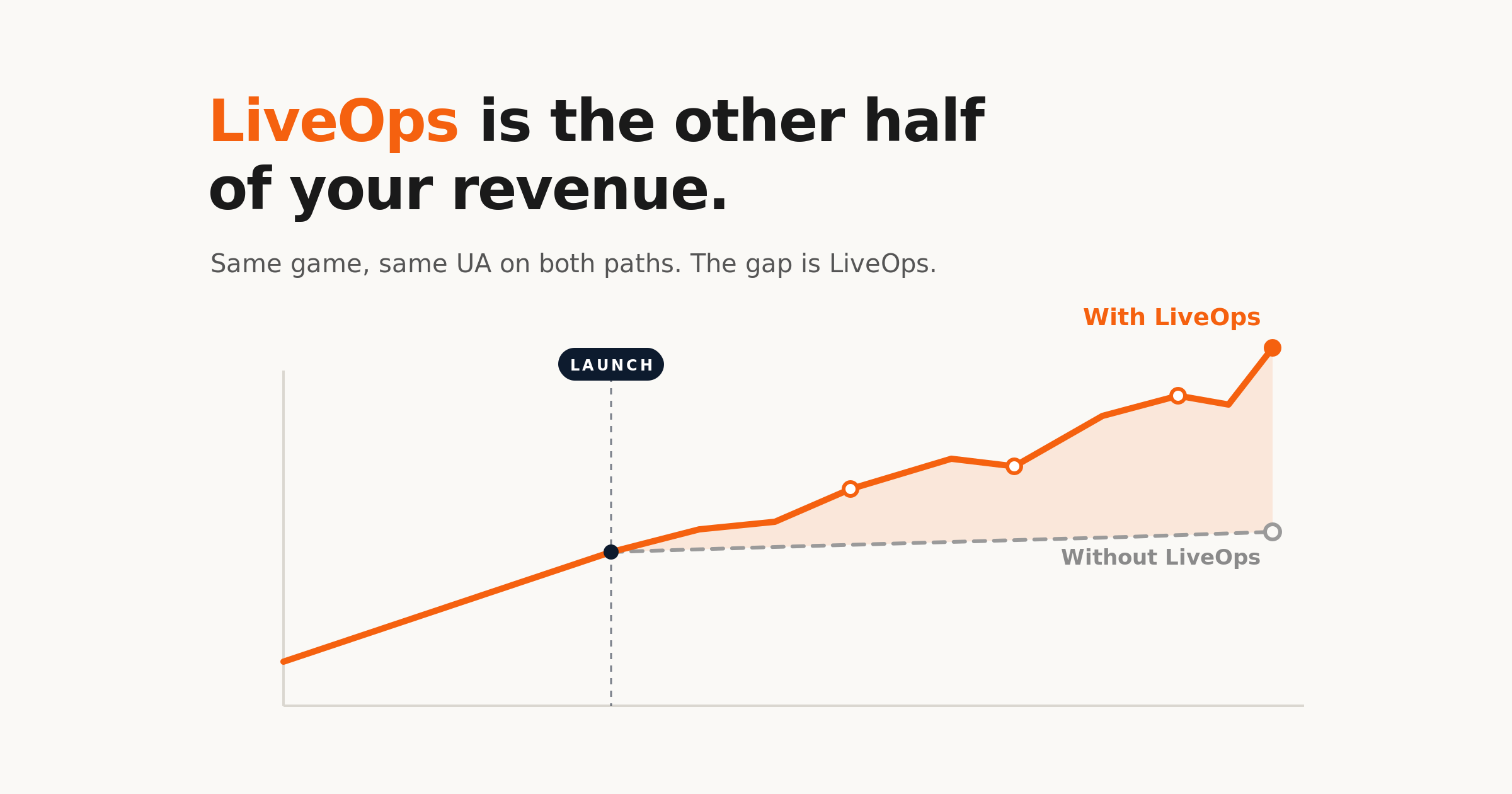
An uncomfortable truth sits underneath the mobile app economy: more operational effort is producing less revenue. Last year, 78 percent of the top 1,000 mobile games saw revenue decline. These are not neglected apps. Most run more events, offers, and messages than ever, and get less back for it.
Yet a handful of titles pulled away. The difference was never how much they operated, but the precision and cadence, fine tuning the value exchange for every segment, every day, without letup.
Operations became the bottleneck
For a decade, growth was gated by acquisition: buy installs, monetize, repeat. That lever is maxed out. Last year, remarketing budgets grew roughly 37 percent while user acquisition spend crept up just 3 percent, the industry turning to the users it already has.
But that only moves the constraint. Reaching those users at the right moment takes a precision no human workday can sustain. The biggest studios throw a full LiveOps team at it and still fall short; most cannot afford that team at all. Operations, not ideas, became the ceiling.
I spent my career on the acquisition side of this business. I founded Adquant and Adotomi to help mobile app companies optimize how they buy users, and spent years in performance marketing at Kenshoo, now Skai. I watched the math that powered a decade of mobile growth stop working, and it convinced me the next decade would be won inside the app, not at the top of the funnel. That is the conviction we built Kinoa on.
What agentic AI already proved
We are not the first industry to hit this wall. Agentic AI is already reshaping software delivery: teams that once spent two week sprints hand building features now run near continuous cycles, agents executing overnight while humans review and set direction in the morning. McKinsey has documented threefold to fivefold productivity gains and roughly 60 percent smaller teams. The human role did not disappear, it moved up a level, from producing the work to supervising the system that produces it.
App operations is heading the same way. It is high volume, pattern rich, and never stops, exactly what agents are built to carry. The operator of the near future will not build one flow at a time. They will set the goal, the guardrails, and the brand, then supervise a system of agents that does the rest.
The mobile market is entering a period where operational intelligence, not creative spend, will determine which studios compound and which stall, and we invest where AI is the underlying operating architecture, not bolted onto a legacy product.
- Andrew Sheppard, Managing Director Transcend Fund, Kinoa Investor
The autonomous operator we are building
This is not faster LiveOps. It is a different kind of operation: everything a good team does today, but at a speed, resolution, and scale no human team can reach. That is the direction we are taking Kinoa, and five capabilities define it.
Creation on the fly. The deepest shift is not better targeting, it is agents that build the experience itself. A multi agent layer will propose a segment, assemble a full user flow, and generate the in app content to fill it, offer, copy, and creative, on brand, turning ideas no team had time to ship into live experiences.
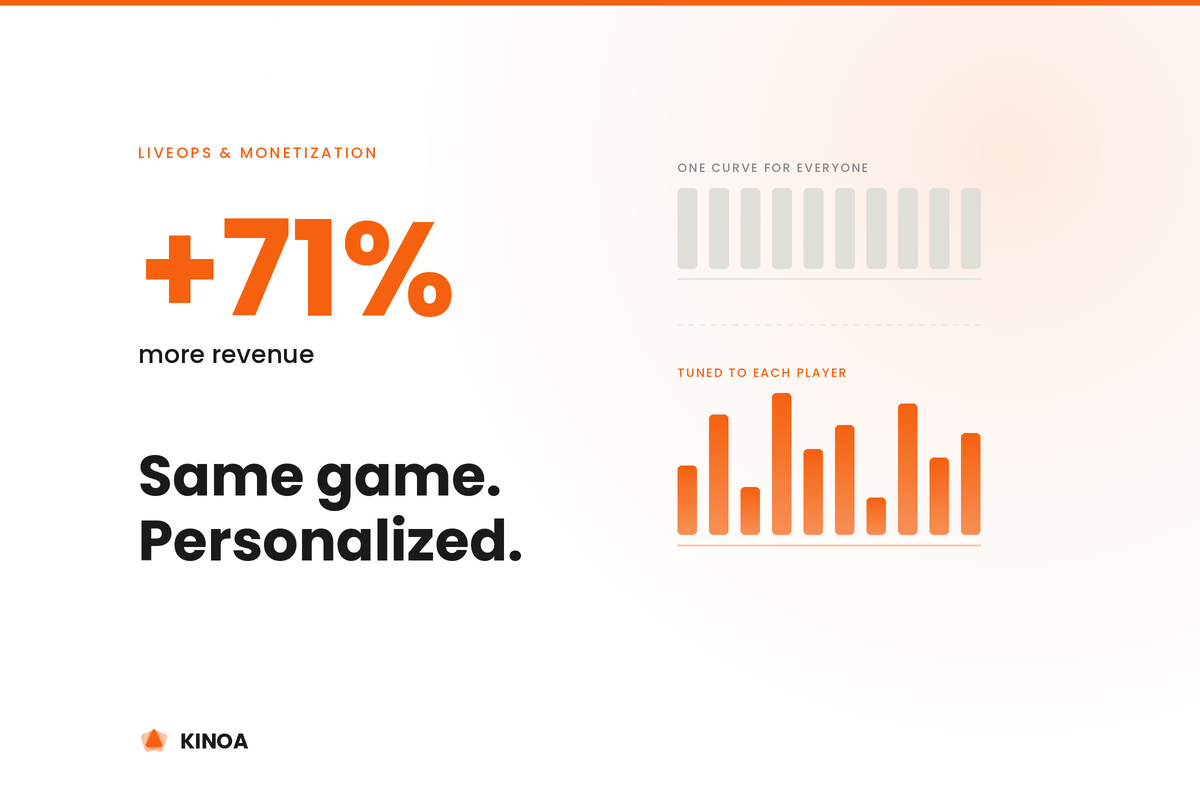
Personalization down to the individual, in real time. Manual LiveOps ships a few broad segments the same experience. Kinoa's segments already update the instant a user's state changes, and with agents on top, personalization becomes a per user decision, the right flow, offer, and content for that exact person at that exact moment. Not the segment. The user.
Continuous testing at a scale humans cannot run. Even the best teams run a handful of A/B tests at once, because each one needs someone to design, launch, and read it. Agents will run experiments in parallel across pricing, timing, creative, and flow, promote winners automatically, and start the next round. Optimization becomes constant, not a weekly ritual.
Prediction that acts before a human could see it. By the time churn shows on a dashboard, it has already happened. Predictive models flip that order, spotting who will leave, who will pay, and who will respond to an offer before a human can. Because insight and execution already sit in one place at Kinoa, the system can act the moment a user is flagged, while it still changes the outcome.
Operations that never sleep. A human team works in shifts, with finite hours. Your users do not. Agents will run every hour of every day, acting on a 3 a.m. opportunity as readily as a 3 p.m. one. None of the other four reach full power when the system pauses.
The operator stays in charge
None of this removes the human. It amplifies them. The agents will draft, test, and execute, but the operator stays in the loop on every decision that matters, setting strategy, approving direction, and owning the brand and guardrails. Nothing ships that a person did not sign off on. What we are building is not an autopilot but a cockpit: one person directing a system that acts across millions of users at once, with the impact that used to take a ten person team. The human is not replaced. The human is made superhuman.
Precision, not pressure
The obvious fear is that automating monetization just means more offers, more pushes, more pressure, until players burn out. That is the wrong way to use it: automation on a blunt strategy only industrializes the spam. Prediction and per user personalization point the other way, toward fewer, better timed moments. A system that knows who is about to churn, who is ready to pay, and who wants to be left alone can stop blasting everyone and start respecting each player. Retention and trust are the same asset. The incentive is precision, not pressure.
Why this needs an operating system
This is where most AI in the category stops short: prediction without the ability to act is just advice. An intelligent operating system needs a body, an execution layer that turns a decision into a live segment, flow, offer, or feature change in real time, without a code release. That layer, not the model, is the hard part. Kinoa spent years building it, the segments, flows, messaging, and remote config operators run today. The autonomous layer on top, the agents that decide and create, is what we are building next.
That order matters, because it changes what the system learns. When insight and execution live in one loop, every action feeds the next prediction: ask, decide, execute, optimize, sharper each time. We are building Kinoa around that loop, because once it closes, it is what separates the apps that compound from the ones that stall.
This goes well beyond games
We started in mobile games because that is where app operations are most mature. But predicting user behavior and acting on it in real time is not specific to games. Streaming, education, productivity, and entertainment apps all live or die on the same questions: who is about to leave, who is ready to pay, and what should they see right now. Every one of them will need an operating system that answers those questions and acts automatically.
We raised $10 million to build exactly this, and companies like Playstudios, Playsimple, and MTG already run their operations on Kinoa today. The next decade of app monetization will not belong to the teams that operate the hardest, but to the ones that operate the smartest, with a few people directing a system that never sleeps. That is the company we are building, and we are opening it to the studios and mobile app companies who want to get there first. If you would rather operate smarter than harder, schedule a call and we'll show you how.